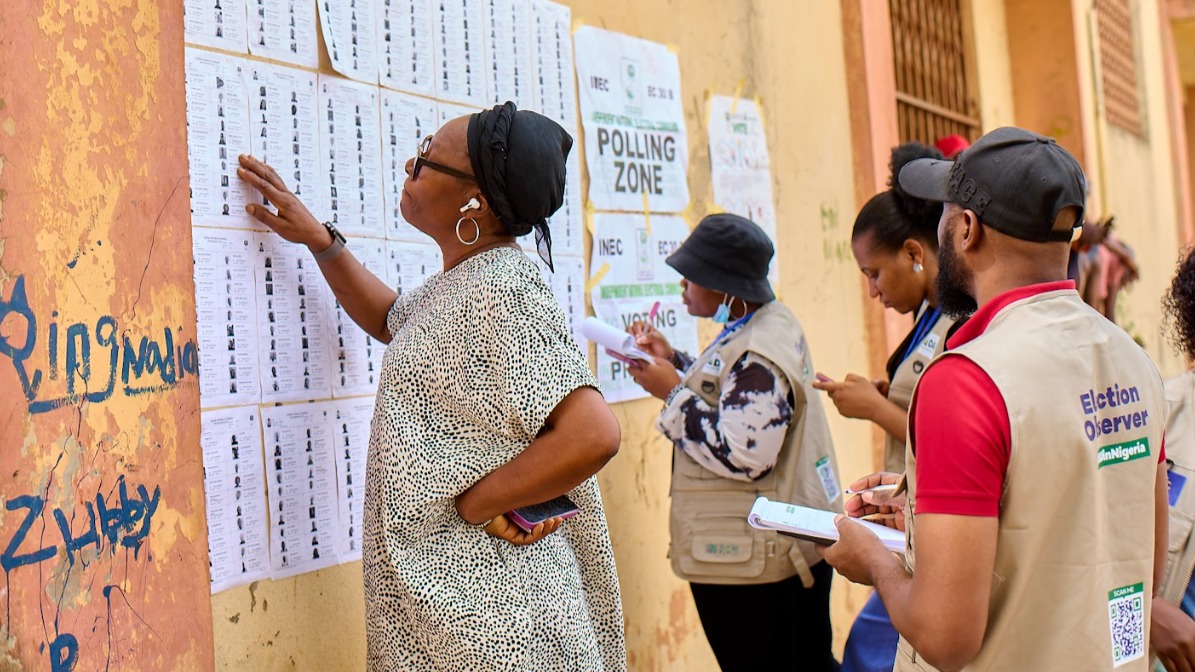
The European Union Support to Democratic Governance in Nigeria (EU-SDGN) is set to deploy 150 observers and 25 sign language interpreters to assist the Independent National Electoral Commission (INEC) in communicating with people with learning impairments for the November 8 governorship election in Anambra.
The Inclusivity Cluster of the EU-SDGN, led by the Chief Executive Officer (CEO) of TAF AFRICA, a Disability Inclusion Champion that promotes the rights and well-being of persons with disabilities (PWDs), Jake Epelle, disclosed this during a visit to the Acting Chairman of INEC, May Agbamuche-Mbu, on Monday in Abuja.
Epelle said the visit is to ask for the continuous partnership with the electoral commission to ensure an all-inclusive election in Anambra State.
He said: “We’re asking for continuous partnership because we’ve already been partnering with you. But our spotlight is Anambra State because we’re deploying huge resources. We’re deploying 150 observers across the state. For the first time, we are deploying 25 sign language interpreters. And we are involved in training, all kinds of training.”
“But I think the most remarkable thing we’ve done recently was our stakeholders’ outing, which is the first live event that focused on the Anambra election. We were able to bring the security operatives, civil society, persons with disabilities, and we had a robust discussion,” he said.
He expressed satisfaction in what they were able to do with his colleagues, saying, “We were supposed to be people that have been left behind. And we turned out to be the first to flag off the Anambra election, especially the preparedness of INEC.”
“We were quite impressed with how everything went. But we still have a lot to do,” he added.
In his remarks, the Assistant Programme Manager at TAF AFRICA, George Dominic, noted that there are lots of other areas they can still work together on to improve the inclusion of persons with disabilities in the election.
He said one of their targets is to see how they can work with the Association of Sign Language Interpreters in Nigeria to deploy SLIs (sign language interpreters) at the Anambra elections to support INEC ad hoc staff.
“You know, during the elections, ad hoc staff want to communicate with the voters, and part of those voters are persons with hearing impairments. And you would have challenges communicating with the deaf voters,” he said.
While noting that deploying sign language interpreters has been recognised as one of the reasonable steps that INEC should take to ensure inclusivity, he said one of the challenges for the commission would be funding.
He said: “When you don’t have enough funds, you won’t be able to deploy SLIs in all polling units in the federation or wherever an election is taking place. So we thought it wise to have a pilot to just deploy 25 SLIs at specific polling units with voters who are deaf, so that they will support ad hoc staff when they are giving out instructions.”
He, however, maintained that bridging the communication gap between INEC and deaf voters is important.
Responding to EU-SDGN, Mbu, who was represented by the National Commissioner/Chairman Outreach and Partnerships Committee (OPC), Prof. Kunle Ajayi, appreciated the organisation for its support to the Commission and accepted the offer to collaborate with INEC.
He gave an updated breakdown of polling units for persons with disabilities in Anambra State as of 2025, totaling 3,548.
According to him, 1,014 polling units are for albinism, 569 for visual impairment, 435 for hearing impairment, 662 for physical/MOB impairment, and 776 for others. He, however, pledged to submit the demands to the Commission for further feedback.