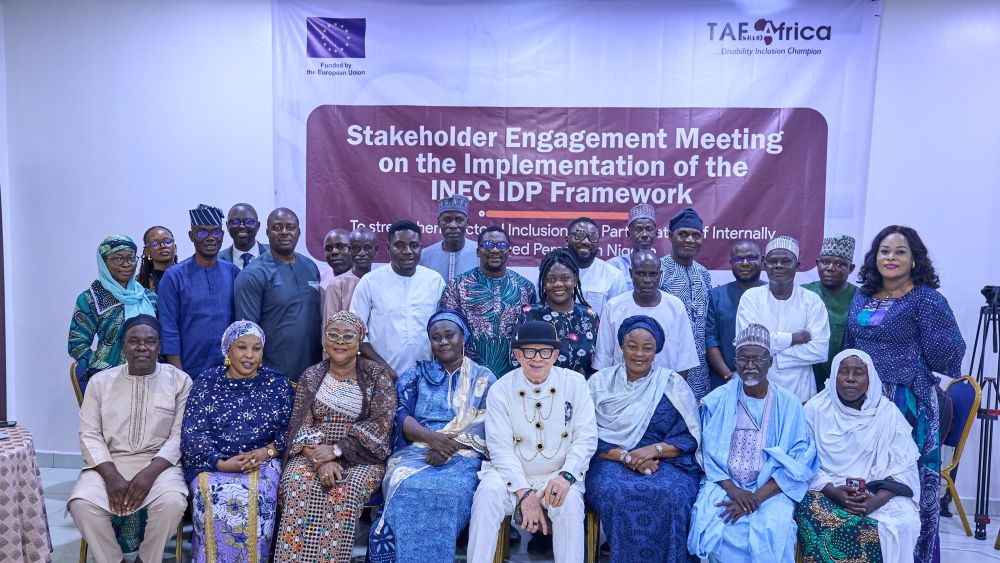
In order to support efforts by electoral authorities and other democratic institutions in driving inclusive political participation ahead of the 2027 general elections, the European Union, through its Support to Democratic Governance in Nigeria (EU-SDGN) programme, has launched the Able2Run campaign aimed at increasing the participation of persons with disabilities (PWDs) in Nigeria’s electoral process.
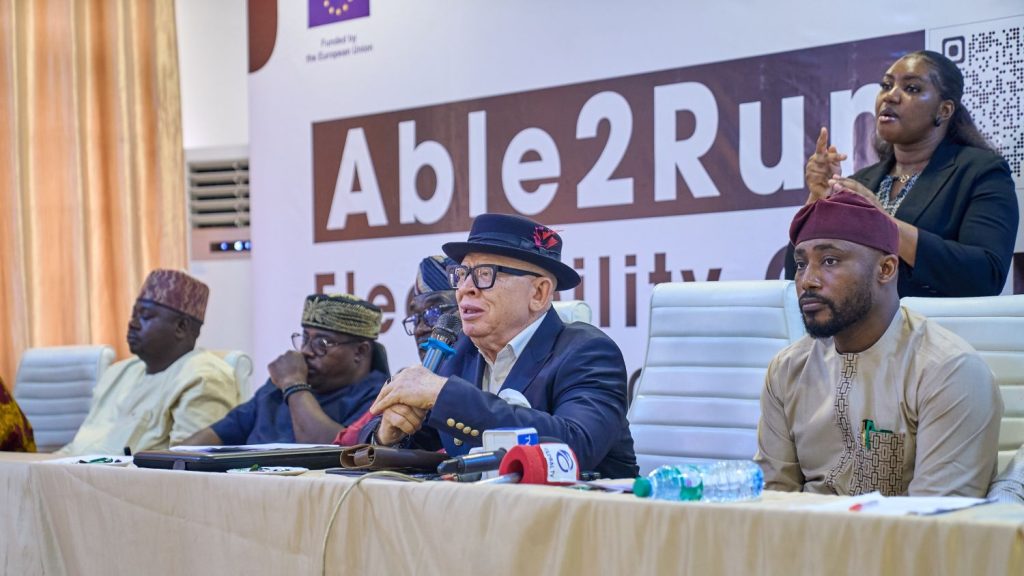
The campaign was launched in Abuja on Tuesday as part of broader efforts under the EU-SDGN programme to promote inclusive governance, equal political participation, and representation for marginalised groups in Nigeria’s democracy. The initiative seeks to encourage persons with disabilities to participate actively in politics, not only as voters, but also as aspirants, candidates, elected officials, and political leaders at all levels of governance.
The statement was delivered at the launch event by the Chief Executive Officer of TAF Africa, Jake Epelle, whose organisation is implementing the disability inclusion component of the EU-SDGN programme.
Mr Epelle said the campaign was designed to challenge stereotypes that equate disability with inability and to push for greater political inclusion of PWDs in Nigeria’s democratic process.
“A democracy that excludes millions of persons with disabilities from political leadership and decision-making cannot truly claim to be inclusive, representative, or just,” he said.
According to him, Nigeria has an estimated 34.9 million persons with disabilities, representing a significant voting bloc capable of influencing electoral outcomes if properly mobilised and politically organised.
Citing figures from the 2023 presidential election, Mr Epelle noted that the total votes secured by President Bola Ahmed Tinubu were far below the estimated number of persons living with disabilities in the country.
“This comparison underscores the political strength this constituency possesses. If mobilised and politically organised, persons with disabilities represent a voting bloc large enough to influence elections and potentially produce elected leaders at every level,” he said.
The EU-supported initiative comes amid concerns over the low level of political representation for persons with disabilities across the country, despite existing legal protections under the Discrimination Against Persons with Disabilities (Prohibition) Act, 2018, and international obligations under the United Nations Convention on the Rights of Persons with Disabilities.
Findings presented at the launch showed that between 2019 and 2025, only four persons with disabilities occupied elective political offices across Nigeria, representing less than 0.1% of elective positions nationwide. The findings also showed that none of the elected officials identified during the period were women with disabilities, highlighting what stakeholders described as a significant representation gap.
Mr Epelle said that while over 200 persons with disabilities currently occupy political positions, more than 99% of them are serving in appointive capacities rather than through electoral mandates.
“The time has come to move from symbolic inclusion to substantive representation. Persons with disabilities must no longer remain at the margins of political participation,” he said.
As part of the campaign, the EU-SDGN programme also announced the opening of a national mentorship and coaching initiative for aspiring politicians with disabilities interested in contesting elective offices, including councillorships, chairmanships, governorships, National Assembly seats, and the presidency.
The programme aims to establish virtual political incubation hubs across Nigeria’s six geopolitical zones and provide mentorship support for at least 180 aspiring politicians with disabilities.
Participants will receive training in leadership, campaign financing, voter mobilisation, strategic communication, political negotiation, and inclusive governance.
Mr Epelle also issued a series of calls to action directed at political parties, the Independent National Electoral Commission (INEC), government institutions, and the wider Nigerian public.
“We call on political parties to adopt deliberate disability inclusion policies, make nomination forms affordable for persons with disabilities, and remove discriminatory barriers that continue to exclude qualified aspirants,” he said.
He further urged INEC to strengthen disability-disaggregated voter data and enforce inclusion guidelines for political parties, while calling on Nigerians to support competent candidates with disabilities.
“Leadership is about vision, integrity, competence, and service, not physical condition,” Mr Epelle submitted.