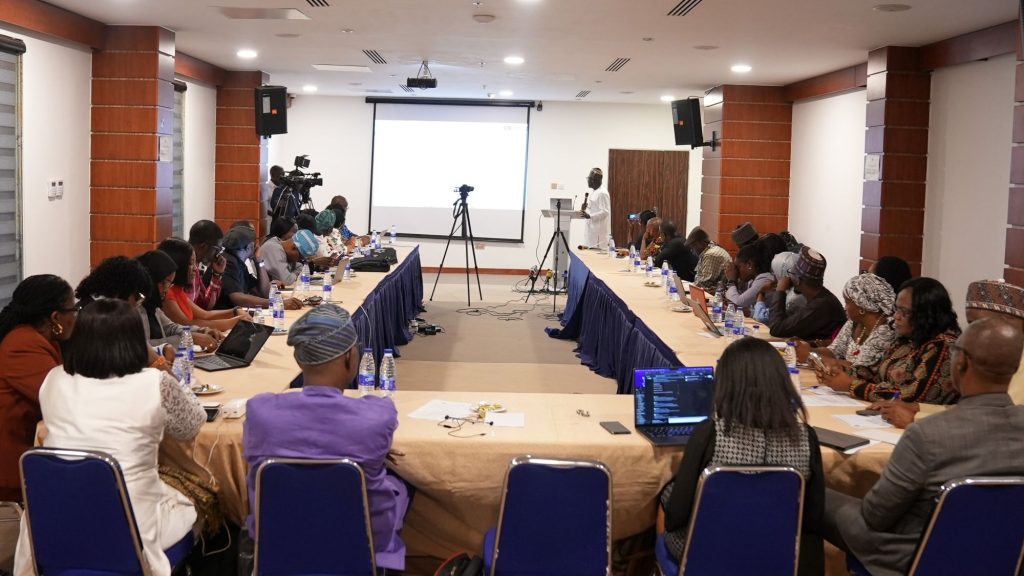
In continuation of its sustained effort to support the deepening of Nigeria’s democracy through unrestricted access to information and a free press, the European Union Support for Democratic Governance in Nigeria (EU-SDGN II) programme has convened a two-day technical stakeholders’ consultative meeting in Abuja.
The event was held from Monday, 28 July to Tuesday, 29 July 2025. It brought together representatives from civil society, the media, legal and academic circles, and key government institutions to evaluate proposed amendments to the 2011 FOI Act.
Delivering his opening remarks, the Executive Director of the International Press Centre (IPC), Lanre Arogundade, emphasised the urgency of proactive reforms and charged stakeholders and lawmakers to ensure that proposed amendments to Nigeria’s Freedom of Information (FOI) Act strengthen, rather than dilute, citizens’ right to know.
“What’s at stake is not just a piece of legislation—it’s the democratic right of Nigerians to hold power to account,” he said. “We must not allow the amendment process to become a backdoor for weakening transparency.”
On his part, while speaking, the Executive Director of CEMESO, Dr. Akin Akingbulu, described the forum as a vital space to “deepen our collective reflection” on the right to access information in Nigeria. He stressed that 14 years after its passage, many public institutions still treat the FOI Act as a favour rather than a binding obligation.
“We must ensure that the ongoing legislative process does not weaken the FOI Act. This is not the time for regression,” Dr. Akingbulu said.
Legal analyst Barrister Jumoke Olatunji warned that some proposed amendments risk introducing overly broad security exemptions and vague enforcement procedures. “Any amendment that narrows access or raises new barriers may be unconstitutional. We must strengthen—not shrink—the democratic space,” she cautioned.
Lanre Arogundade, Executive Director of IPC, highlighted comparative global models from South Africa, India, and Mexico. He called for a new compliance architecture, possibly an independent FOI Commission, and recommended a shift towards digitalisation and proactive disclosure.
PLAC’s representative, Ms. Nkiru Uzodi, underscored the need for inclusive reform driven by civil society and legislative collaboration, while the Federal Ministry of Justice reaffirmed its openness to reforming the Act for improved transparency.
The stakeholders used the forum to reaffirm the urgent need for reform of the Freedom of Information (FOI) Act to guarantee enforcement, compliance, and digital transparency.
The consensus at the end of the meeting was a shared commitment to update the FOI framework, specifying stiffer and clearer sanctions, guaranteeing digital access, institutional accountability, and stronger oversight.