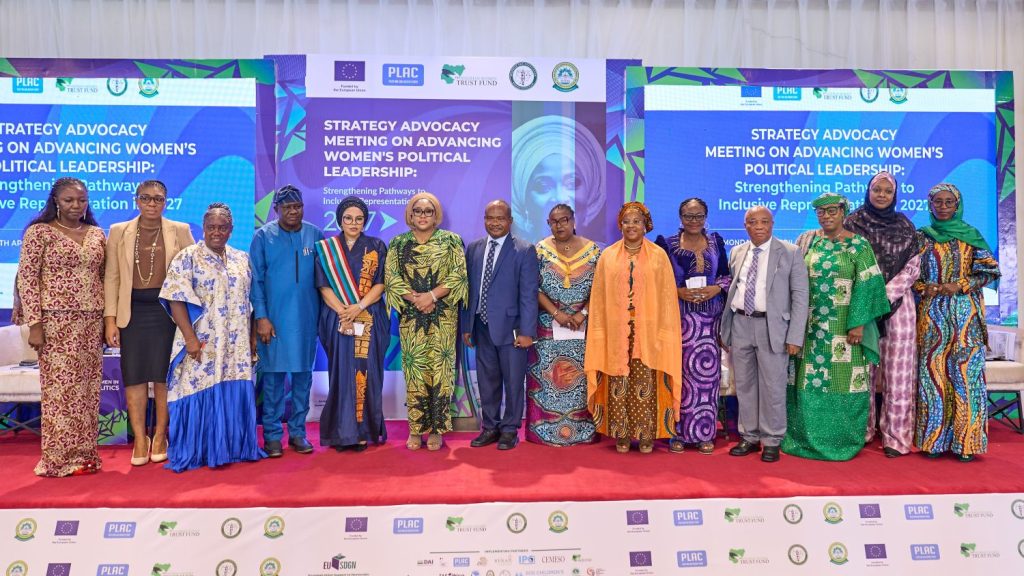
Ahead of Nigeria’s 2027 general election, the European Union has intensified efforts to advance women’s political participation through a high-level strategy meeting held in Abuja on Monday.
The meeting was organised by the Policy and Legal Advocacy Centre and the Nigerian Women Trust Fund, both cohort members of the European Union’s flagship democratic governance programme, the European Union Support to Democratic Governance in Nigeria (EU-SDGN), in collaboration with the Nigerian Bar Association Section on Public Interest and Development Law (SPIDL).
The meeting, themed Advancing Women’s Political Leadership: Strengthening Pathways to Inclusive Representation in 2027, brought together lawmakers, civil society actors, development partners, and political stakeholders to assess progress on women’s inclusion and the proposed Special Seats Bill, while mapping strategies ahead of the next electoral cycle.
Speaking at the event, Laolu Olawumi, Governance and Gender Adviser at the European Union Delegation to Nigeria and ECOWAS, emphasised the importance of political will in advancing women’s representation. She noted that as the 2027 elections approach, the constitutional reform process presents a critical opportunity to promote inclusion, stressing that women’s participation remains essential for equality, development, and democracy despite persistent barriers.
Executive Director of the Policy and Legal Advocacy Centre, Clement Nwankwo, raised concern over the underrepresentation of women in state legislatures, noting that fifteen states currently have no female representation in their State Houses of Assembly, a situation he described as a significant gap in Nigeria’s democratic inclusion.
He emphasised the urgency of passing the Special Seats Bill, stating that without it, broader constitutional amendments would fall short of meaningful progress on inclusion.
Chief Executive Officer of the Nigerian Women Trust Fund, Brenda Anugwom, highlighted structural barriers that continue to limit women’s access to leadership. She noted that although women actively participate as voters and campaign supporters, they remain significantly underrepresented in decision-making spaces.
Chairperson of the Nigerian Bar Association Section on Public Interest and Development Law, Associate Professor Uju Agomoh, called for a shift from dialogue to action, expressing concern over the persistent lack of inclusiveness in Nigeria’s political system.
In a goodwill message, the First Lady of Edo State, Mrs Edessii Anani Okpebholo, underscored the importance of women’s involvement in governance, noting that national development remains incomplete without their active participation and that women must move beyond symbolic roles during elections to full inclusion in decision-making processes.
President of the Nigerian Bar Association, Mazi Afam Osigwe, SAN, called for greater trust in women’s leadership capabilities, emphasising that women have consistently demonstrated competence in leadership roles.
Also speaking, Gaza Jonathan Gbefwi, a member of the House of Representatives, expressed optimism about the prospects of the Special Seats Bill, citing growing momentum and national attention. He, however, stressed the need to address cultural, religious, and societal barriers that continue to hinder women’s full participation, while promoting new narratives that support inclusion.
The meeting concluded with renewed calls for sustained advocacy, stronger political commitment, and institutional reforms within political parties and governance structures to improve women’s representation ahead of the 2027 elections.